Open blank calendar on wooden table in soft natural light

Understanding Realistic Expectations in Long-Term Body Weight Change

Educational content only. No promises of outcomes.

Explore the physiological realities, research evidence, and psychological dimensions of sustainable weight change without commercial influence or promises.

Energy Balance Equation Basics

At its foundation, body weight change relates to energy balance—the relationship between calories consumed and calories expended. However, real-world application of this principle is far more complex than simplified summaries suggest.

Why Real-World Variability Matters

Individual responses to the same energy deficit vary significantly due to metabolic efficiency, activity patterns, food quality, stress levels, sleep, and numerous other factors. The basic equation holds true over long periods, but day-to-day and week-to-week variations obscure the underlying relationship.

Energy balance is fundamentally true, but its predictive power for individual short-term outcomes is limited by biological and behavioural variability.

Minimalist vector illustration of energy balance concept
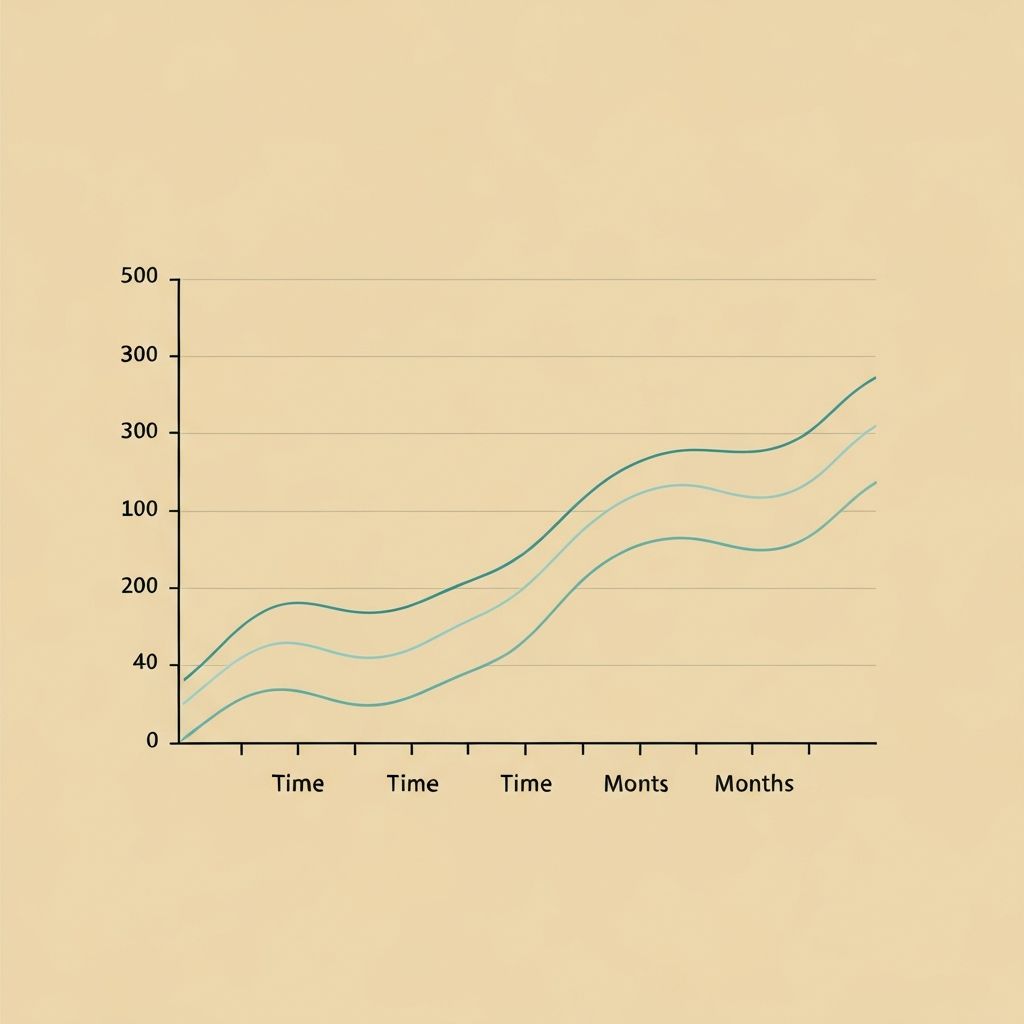
Minimalist line graph showing realistic rate of change over months

Typical Observed Rates of Change

Research on free-living weight change and controlled intervention studies consistently report sustainable fat loss rates within a particular range. Understanding these ranges helps contextualise realistic expectations.

Research Evidence on Sustainable Ranges

Controlled studies on fat loss typically observe rates of approximately 0.25–1% of body weight per week as a sustainable upper limit. This translates to highly individual outcomes: a 70 kg person might expect 0.175–0.7 kg per week, while a 100 kg person might observe 0.25–1 kg per week under similar conditions.

Initial weeks often show greater losses due to water and glycogen depletion, not fat. After approximately 2–4 weeks, the rate typically declines toward fat loss alone.

Rates vary widely based on age, sex, starting composition, genetics, and lifestyle factors—not individual motivation or willpower.

Physiological Limits of Fat Oxidation

The human body has inherent physiological limits to how quickly fat can be mobilised and oxidised for energy. These limits exist to protect lean tissue and maintain essential metabolic functions.

Metabolic Adaptation and Plateau Phases

As energy deficit persists, adaptive metabolic responses gradually reduce expenditure. Hormonal shifts lower metabolic rate, activity spontaneously decreases, and the body conserves energy. These are normal physiological responses—not personal failure.

A plateau phase is not permanent stagnation but rather a new equilibrium where continued deficit requires adjustment to either intake or activity. Understanding this prevents misinterpretation of plateaus as evidence of ineffectiveness.

Adaptation is an evolved survival mechanism, not evidence of personal failure or metabolic damage.

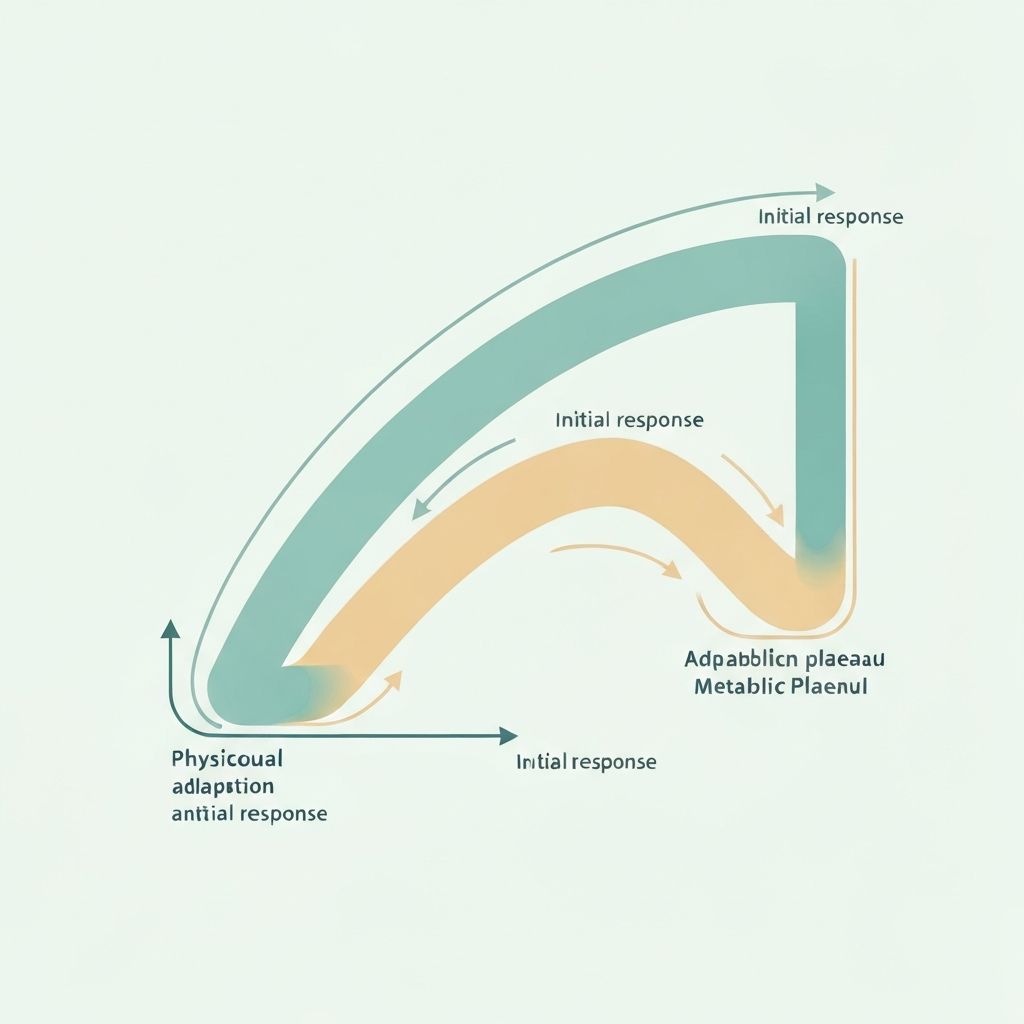
Abstract minimalist illustration of physiological adaptation phases
Empty kitchen scale on clean white surface in soft natural light

Scale Weight vs True Fat Loss

Scale weight reflects total body mass: fat tissue, lean muscle, water, glycogen, food residue, and other components. True body composition change—specifically fat loss—is only one contributor to scale weight fluctuations.

Why Scale Weight Masks True Fat Loss

Water retention from hormonal cycles, high sodium intake, intense exercise, or stress can temporarily mask fat loss for days or weeks. Conversely, dehydration can temporarily inflate weight loss rates. Lean mass changes—whether muscle gain or loss—also affect scale weight independent of fat change.

Because scale weight fluctuates daily by 1–3 kg or more due to these factors, short-term (days to weeks) scale changes are poor indicators of fat loss. Longer timeframes (weeks to months) and multiple measurement methods provide better context.

The scale measures weight, not health or progress. Understanding this distinction prevents misinterpretation of normal physiological fluctuations.

Psychological Goal-Setting Constructs

Research in behavioural psychology identifies multiple goal-setting approaches, each with different relationships to long-term adherence and satisfaction.

SMART vs Process-Oriented vs Outcome-Focused

SMART goals (Specific, Measurable, Achievable, Relevant, Time-Bound) provide structure but can become sources of distress if outcomes fail to materialise as planned. Process-oriented goals (focus on behaviours like consistency, learning, habit formation) tend to support longer-term adherence and psychological resilience. Outcome-focused goals may motivate initially but often fail when outcomes plateau.

Research on goal specificity and self-efficacy suggests that flexible, process-oriented approaches combined with realistic outcome expectations yield better long-term engagement and psychological wellbeing.

Goals that emphasise controllable processes over uncontrollable outcomes tend to support both adherence and psychological resilience.

Minimalist vector diagram showing psychological concepts
Minimalist arrangement of whole foods in soft natural light

Expectation-Reality Mismatch Patterns

Common patterns emerge when individual expectations diverge from actual physiological and behavioural realities.

Initial Rapid Loss vs Later Plateau

Initial weeks often show rapid scale weight loss (primarily water and glycogen), creating optimism about outcome rates. As this water is replaced and true fat loss continues at a slower, more sustainable rate, many individuals interpret the slowed rate as "failure" rather than normal physiology.

Linear vs Non-Linear Trajectories

Weight change is not linear. Short-term fluctuations from water retention, hormonal cycles, meal timing, and activity naturally create apparent "stalls" and "whooshes." Interpreting these as evidence of success or failure misses the broader trajectory.

Individual Variation Often Exceeds Expectations

Two people following identical energy deficits experience different rates of change. This variation reflects age, sex, starting composition, genetics, metabolic history, and numerous other factors—not adherence or effort differences.

Research on Adherence and Self-Efficacy

Long-term behaviour change research identifies several factors that predict sustained engagement:

Factor Relationship to Long-Term Adherence
Self-efficacy (confidence in ability) Strong predictor of sustained effort and resilience through difficulties
Intrinsic motivation (internal drive) Associated with longer-term persistence than extrinsic rewards alone
Process focus (controllable behaviours) Supports resilience when outcomes plateau or progress slows
Social support and community Protective factor against dropout during difficult periods
Flexible approaches and self-compassion Reduces all-or-nothing thinking and supports return after lapses

Individual Factors Affecting Rate of Change

Why do individuals respond differently to similar energy deficits? Research highlights multiple biological, behavioural, and contextual factors:

Age: Metabolic rate and muscle tissue changes vary with age. Older adults typically experience slower fat loss rates and greater lean tissue loss in extreme deficits.

Sex: Hormonal differences, including menstrual cycle effects and oestrogen levels, influence water retention, hunger hormones, and adaptive responses.

Starting Body Composition: Individuals with higher starting fat percentages may initially experience faster rates; as fat percentage decreases, rates typically slow.

Genetics: Twin studies confirm heritable differences in metabolic efficiency, adaptive responses, and satiety hormone sensitivity.

Metabolic History: Prior extreme dieting, repeated weight cycling, and long-term caloric restriction can alter adaptive responses and metabolic efficiency.

Lifestyle Factors: Sleep quality, stress levels, physical activity patterns, food quality, alcohol intake, and medical conditions all influence rate of change independently of energy balance alone.

Links to Detailed Expectation Explorations

Discover deeper explorations of specific topics related to realistic expectations and physiological realities.

Frequently Asked Questions

What is a realistic rate of weight loss? +
Research suggests sustainable fat loss rates of approximately 0.25–1% of body weight per week for most individuals. This varies based on age, sex, starting composition, genetics, and lifestyle factors. Initial weeks may show higher rates due to water loss, but true fat loss typically emerges after 2–4 weeks.
Why does weight loss slow down over time? +
Multiple factors contribute: metabolic adaptation (reduced energy expenditure during sustained deficit), depletion of easy-to-mobilise water and glycogen stores, and potential compensatory changes in activity or intake. These are normal physiological responses, not evidence of failure.
What causes weight plateaus? +
Plateaus reflect a new energy balance equilibrium where intake and expenditure have adjusted relative to each other. Continued deficit requires further changes to intake or activity. Plateaus are also masked by short-term water fluctuations masking underlying fat loss.
How much of weight loss is water vs fat? +
Initial loss (first 1–2 weeks) is predominantly water and glycogen. After that, the proportion shifts toward fat loss as water stores stabilise. However, water fluctuations continue throughout due to diet, hormones, activity, and stress—making short-term scale changes poor indicators of fat loss.
Do individual differences in weight loss rate matter? +
Yes, significantly. Age, sex, starting body composition, genetics, metabolic history, and lifestyle factors create wide variation in response to identical energy deficits. This variation is biological, not behavioural—it does not reflect effort or adherence differences.
What is metabolic adaptation? +
During sustained energy deficit, the body reduces metabolic rate through hormonal and neurological adjustments, partly to preserve lean tissue and maintain essential functions. This is an evolved survival mechanism. It makes continued deficit require greater effort but is not permanent.
Why is the scale weight not a complete picture? +
Scale weight includes fat, muscle, water, glycogen, food residue, and other tissues. Changes in any of these affect scale weight independent of fat loss. Water and glycogen fluctuations alone can create 2–3 kg variations daily, masking true fat loss patterns.
How do goal-setting approaches affect long-term success? +
Research suggests process-oriented goals (focus on behaviours) tend to support longer-term adherence and psychological resilience compared to rigid outcome-focused goals. Flexible approaches that emphasise controllable processes show better long-term engagement.
What factors predict long-term adherence? +
Self-efficacy, intrinsic motivation, process focus, social support, and self-compassion are strong predictors of sustained engagement. Rigid goal-setting and external motivation alone are weaker predictors of long-term maintenance.
Where can I learn more about this topic? +
Explore the detailed articles linked on this site under "Realistic Change Explorations" or visit academic databases such as PubMed for peer-reviewed research on energy balance, metabolic adaptation, and behaviour change. Always consult qualified professionals for individual guidance.


Continue Exploring Energy Balance Realities

Discover deeper research, individual case studies in context, and detailed physiological explanations.

Explore Realistic Change